
Do You Need Homeowners Insurance for VA Loans In Florida?
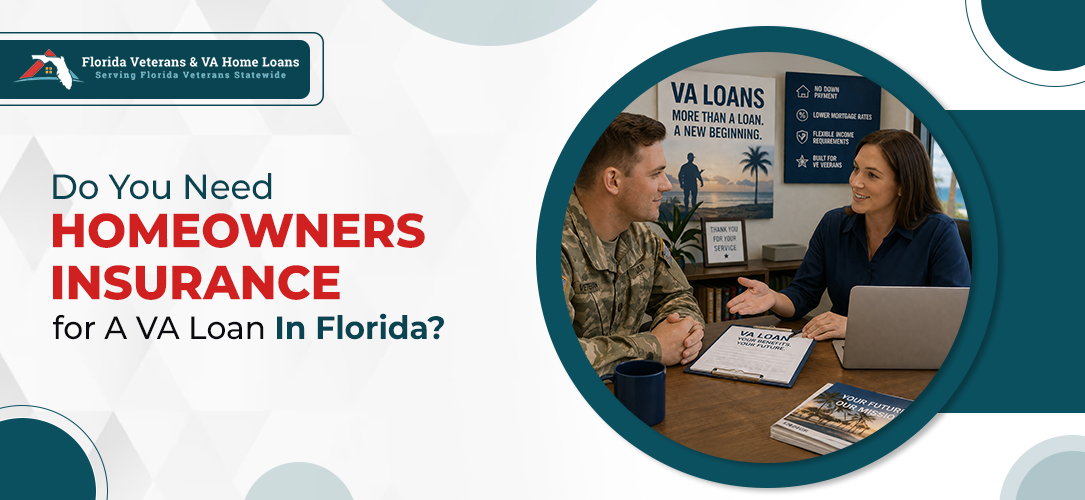
Homeowners insurance is an important part of buying a home with a VA loan in Florida.
While the VA loan program does not provide homeowners insurance, lenders generally require adequate property or hazard insurance before closing and throughout the mortgage term.
Florida’s exposure to hurricanes, windstorms, flooding, and other property risks can also affect the coverage your home requires.
If you are using a VA loan to purchase a home in Florida, understanding the insurance requirements early can help you avoid closing delays and unexpected costs.
This guide explains what coverage you may need, who determines the requirements, how flood and windstorm coverage works, and how homeowners insurance can affect your monthly VA loan payment.
Quick Answer: Do VA loans require homeowners insurance in Florida?
Do VA loans require homeowners insurance in Florida? Yes, generally. Your VA lender will require adequate hazard or property insurance before closing and throughout the loan term.
The VA establishes requirements for lenders regarding property insurance. In contrast, the lender determines whether the proposed policy satisfies its underwriting requirements. Still, the exact policy and coverage requirements can vary by lender and property.
| Stage or Requirement | Standard VA Guideline | What You Must Do |
|---|---|---|
| Mandatory Coverage | Generally required: VA lenders typically require acceptable property or hazard insurance on the property securing the loan before closing and throughout the loan term. | Secure an active homeowners insurance policy before your scheduled closing day. |
| Coverage Amount | Sufficient coverage to protect the property. | Confirm with your lender and insurance provider that dwelling coverage meets the lender’s requirements and the property’s estimated replacement cost. |
| Escrow Account | May be required by the lender. | If your lender uses an escrow account, part of your monthly mortgage payment may be set aside for homeowners insurance and property taxes. |
| Additional Coverages | Geographically dependent. | Obtain any separately required flood or windstorm coverage based on the property’s location, insurer requirements, and lender requirements. |
VA Homeowners Insurance Requirements in Florida
Before your VA loan closes, your lender will review your homeowners or hazard insurance documentation to confirm that the property has the required coverage.
They need to be sure you are insured in accordance with federally regulated home loan guidelines. Here are the criteria that apply to you:
1. Homeowners Insurance Is Required Before Closing
Homeowners insurance must be in place before closing. Your lender will require proof of coverage and documentation that meets its underwriting requirements.
2. The Policy Must Cover the Home’s Replacement Cost
Your dwelling coverage should be sufficient to satisfy your lender’s requirements and provide appropriate protection for the home’s estimated replacement cost.
The replacement-cost estimate is generally determined using property-specific information and insurance-industry valuation methods. Your insurance provider and lender can confirm the amount required for your policy.
3. The Lender Must List the Mortgagee
Your lender will generally need to be correctly identified in the policy’s mortgagee information to protect its interest in the property. Correctly listing the lender in the policy protects the lender’s financial interest in the property.
It ensures covered claim payments are handled in accordance with the policy and mortgage requirements.
4. Maintain Required Insurance Throughout the Mortgage Term
You must generally maintain the required property insurance for as long as the mortgage requires it. Allowing coverage to lapse can create problems with your lender and may result in lender-placed insurance.
5. Lenders May Require Additional Property Insurance
The property’s location and exposure to specific risks can affect the additional coverage your insurer or lender may require. Depending on the property’s location and risk level, your lender or insurer may require additional flood- or wind-related coverage. These requirements can vary by property and insurance policy.
VA Homeowners Insurance Requirements Checklist
Use this checklist to make sure your insurance documentation is complete and meets your lender’s requirements before closing. Providing the correct information early can help prevent avoidable delays.
- The address on your policy precisely matches the one in your purchase agreement.
- The dwelling coverage is sufficient to meet your lender’s requirements and appropriately reflects the home’s estimated replacement cost.
- Your lender’s name and the full correct mortgagee clause information are reflected on the policy.
- Your insurance binder or other proof of coverage meets your lender’s documentation requirements. It confirms that the required policy is in effect.
- Your deductible types adhere to typical insurer-lender stipulations.
- Any separately required flood or wind coverage has been obtained and documented in accordance with your lender’s instructions.
Why Do VA Loans Require Homeowners Insurance?
Homeowners insurance protects the property securing the mortgage and helps protect both the borrower and lender against covered losses.
1. Protects the Home Securing the Loan
The collateral backing the mortgage is the property that you will mortgage. If the home suffers damage from a covered event, property insurance can help pay for eligible repairs or rebuilding, subject to the policy’s terms, limits and deductibles.
2. Protects the Borrower’s Investment
Depending on the policy, homeowners insurance can also provide coverage for personal belongings and certain other losses, subject to policy limits, exclusions and deductibles.
Depending on the policy, homeowners insurance may help cover damage to the dwelling and personal property after a covered loss, subject to deductibles, coverage limits, exclusions, and policy terms.
3. Protects the Lender’s Financial Interest
Your mortgage lender may lend hundreds of thousands of dollars secured by the home. Property insurance helps protect the collateral securing that loan against covered losses.
The lender has a financial interest in the property, so maintaining appropriate property insurance helps protect the collateral if the home suffers a covered loss.
Why the VA Guarantee Doesn't Replace Homeowners Insurance?
The VA loan guaranty protects the lender against certain losses if the borrower defaults. It does not provide homeowners insurance or cover property damage. Those risks are addressed through property insurance and, when applicable, separate coverage such as flood insurance.
Who Requires Homeowners Insurance: The VA Or The Lender?
The VA establishes requirements for lenders regarding property insurance. In contrast, the lender determines whether the proposed policy satisfies its underwriting requirements.
| Requirement | Department of Veterans Affairs (VA) | Mortgage Lender | Insurance Company |
|---|---|---|---|
| Homeowners Insurance | Establishes requirements for lenders regarding hazard insurance on properties securing VA loans. | Requires acceptable insurance coverage as part of its underwriting and closing requirements. | Issues the policy and sets underwriting terms. |
| Coverage Amount | Requires sufficient hazard coverage to protect the property. | Determines whether the proposed coverage satisfies its underwriting and collateral-protection requirements. | Evaluates the property and determines the applicable premium, coverage, and underwriting terms. |
| Escrow | Permits lenders to establish escrow accounts. | Establishes and manages the monthly escrow account. | Collects annual premiums directly from the lender. |
What Type Of Insurance Is Required For A VA Loan In Florida?
You generally need property or hazard insurance that satisfies your lender’s requirements.
At the same time, the specific coverage depends on the property, insurer, and applicable risks. Confirm the required policy with your lender and insurance provider.
So let us break down what must be included in that policy.
Not every component of a homeowner’s policy is necessarily a VA loan requirement. Your lender primarily needs acceptable property/hazard coverage for the home securing the mortgage.
Other coverages, such as personal property, liability, and loss of use, are common components of homeowner’s policies but serve different purposes.
- Hazard Insurance: Property or hazard coverage can protect the dwelling against covered causes of loss, such as fire and certain weather-related damage, depending on the policy’s terms and exclusions.
- Dwelling Coverage: Dwelling coverage helps restore your home if the walls, roof, or foundation are destroyed.
- Personal Property Coverage: Personal property coverage helps replace furniture, computers, or clothing you own if a described loss occurs.
- Liability Coverage: Personal liability coverage helps protect yourself if you are sued due to an injury that occurred to someone on your property.
- Additional Structures: This helps repair other structures on your property that may be detached from your house, like sheds or garages.
- Loss of Use Coverage: Loss of use helps cover your temporary living expenses, such as a hotel bill or rental fee. At the same time, work is done to repair your home.
How Much Homeowners Insurance Do You Need For A VA Loan In Florida?
Determining the right amount of coverage for your Florida VA loan can help you meet your lender’s requirements and avoid being underinsured. To find the right home insurance coverage amount for your VA loan in Florida, you will want to investigate local construction expenses.
Your lender will determine the amount of coverage required for the property. In many cases, lenders focus on whether the dwelling coverage is sufficient to protect the property rather than simply matching the outstanding loan balance.
Your dwelling coverage should generally be based on the estimated cost to rebuild the home, rather than the property’s market value or your remaining mortgage balance.
Your insurance provider can help determine an appropriate replacement-cost limit. At the same time, your lender can confirm whether the coverage satisfies its requirements.
For most properties, this figure essentially represents the total cost to reconstruct and rebuild your physical home in local materials and labor.
For most homes, it will not include the value of land itself.
Choosing coverage based solely on your remaining mortgage balance may not provide enough protection to rebuild the home after a total loss covered by your policy.
Discuss the appropriate dwelling limit with your insurance provider and lender.
When Do You Need Homeowners Insurance during the VA Loan Process?
Start shopping for homeowners insurance early in the loan process.
Your lender will tell you when it needs the quote, binder, proof of coverage, and proof of payment. Providing the VA loan documents early can help prevent closing delays.
Here is a breakdown showing when you will need to take care of your insurance actions, step-by-step:
- After Your Purchase Contract Is Signed: Start shopping for insurance once you have a property under contract.
- During Loan Processing: Provide the insurance quote and requested documentation to your lender.
- During Underwriting, your lender reviews the policy or binder to confirm that it meets its requirements.
- Before Closing: Provide any required proof of coverage, payment, and mortgagee information.
- At Closing: Any required prepaid premiums and escrow deposits are reflected in the closing documents.
Is Homeowners Insurance Included In A VA Loan Payment?
It may be. If your lender establishes an escrow account, part of your monthly mortgage payment can be set aside for homeowners insurance and property taxes.
- Monthly Escrow: If your loan uses an escrow account, your monthly payment may include an amount collected toward your annual homeowner’s insurance premium and property taxes, along with any required escrow reserves.
- Paying Separately: Depending on your program, you may be allowed to pay your premiums and taxes separately. Whether insurance and property taxes are collected through escrow depends on the lender and loan arrangement. If an escrow account is used, the lender collects funds with your monthly payment and pays the insurance premium when it comes due.
- Change in Premiums: If your homeowner’s insurance provider raises your policy premiums, you may need to adjust your monthly escrow payments with your lender.
- Escrow Shortage: If an escrow shortage occurs because the amount collected is insufficient to cover your insurance premium or property taxes, your lender will notify you and explain the available repayment options. Your monthly escrow payment may also be adjusted.
What Happens If Your Homeowners Insurance Lapses?
If your required insurance coverage lapses, your lender may obtain lender-placed or force-placed insurance to protect its interest in the property.
The lender purchases force-placed insurance to protect its interests in the building structure only.
Force-placed insurance can be significantly more expensive than coverage purchased directly by the homeowner.
It may provide less protection for your personal property or liability. The easiest way to avoid this hefty financial blow is not to lapse your insurance in the first place.
Does A VA Loan Require Flood Insurance?
Given Florida’s flat topography and extensive coastline, water damage poses a significant financial risk to homeowners.
Yes, flood insurance may be required when the property is located in a Special Flood Hazard Area (SFHA).
- When determining the Flood Zone, lenders obtain official flood zone certification to determine your home’s precise location. This happens after a loan is put in process.
- Official Flood Zone Maps: The Federal Emergency Management Agency’s Flood Maps depict regions at elevated flood risk.
- Requirement to purchase Flood Insurance: If the property is located in an area where federal flood insurance requirements apply, your lender will generally require flood insurance before closing. Your lender will use the applicable flood zone designation and federal requirements to determine whether coverage is mandatory.
- Supplemental flood coverage: Flood insurance may also be worth considering even when it is not federally required, because standard homeowners insurance generally does not cover flood damage.
- Coastal Residences: Coastal and low-lying areas may face greater exposure to storm surge and flooding, but flood risk varies by property location.
Does A VA Loan Require Windstorm Or Hurricane Insurance?
The Sunshine State often experiences high winds and tropical storms. Your mortgage lender has strict standards for how your house is prepared to withstand the dramatic climate along Florida’s coasts. Let us break down how hurricane risk will affect your policy language.
It depends on the property’s location, insurance policy, and lender requirements.
Depending on the property, insurer, and lender requirements, windstorm coverage may be included in the homeowner’s policy or provided through a separate policy or endorsement.
Your lender will determine whether the coverage satisfies its requirements.
Homeowners Insurance Vs PMI Vs VA Funding Fee
Knowing what those different mortgage fees are will help you avoid headaches in the application process. Each requirement has a different reason you need to come up with them at your point of transaction.
Let us look at these three requirements against each other:
Homeowners insurance protects against covered property losses and may provide liability and other coverage. PMI protects a conventional mortgage lender against certain losses associated with borrower default. The VA funding fee helps support the VA loan guaranty program.
| Feature | Homeowners Insurance | Private Mortgage Insurance (PMI) | VA Funding Fee |
|---|---|---|---|
| Purpose | Repairs or helps cover physical damage to your home and belongings. | Protects the lender if you default on your mortgage. | Helps lower the cost of the VA loan program for taxpayers. |
| Mandatory? | Generally required by mortgage lenders as a condition of closing. | No. VA loans do not require PMI. | Yes, unless you qualify for an applicable VA funding-fee exemption. |
| How You Pay | May be paid through a lender-managed escrow account or separately, depending on the loan and lender. | Added as a monthly fee on conventional loans. | May be financed into the loan amount or paid at closing, subject to VA rules and the borrower’s circumstances. |
How Much Does Homeowners Insurance Cost With A VA Loan?
The cost of homeowners insurance in Florida depends on several property-specific and location-specific factors. Insurers will assess all of the following to help determine your exact monthly insurance premium.
- State: Florida’s exposure to hurricanes, severe storms, flooding, and other property risks can contribute to higher homeowner’s insurance costs than in many other states.
- ZIP code: Likely to be higher if the property is near the coast because they tend to experience more wind and flood damage.
- Home age: The age and condition of the home, electrical system, plumbing, roof, and other major components can affect insurance eligibility and premiums.
- Roof condition: Roof age, condition, materials, and remaining useful life can affect insurance eligibility and premiums, particularly in Florida’s property insurance market.
- Claims history: If a property has been subject to water or storm claims in the past, premium quotes will tend to be higher.
- Credit: Insurance pricing can depend on multiple factors, including the property, location, claims history, coverage limits, and insurer-specific underwriting criteria.
- Higher deductible: This will reduce your premium; however, you will need cash on hand to cover it if a storm comes along.
- Coverage limits: Having higher dwelling replacement limits will mean you will pay a higher premium each year.
Common Homeowners Insurance Mistakes VA Buyers Make
Avoid these common insurance mistakes when using a VA loan in Florida:
- Not differentiating PMI and homeowners’ insurance – Realizing “no PMI” means you still have to have property hazard insurance.
- Underestimating the coverage needed: Rising construction costs can increase the cost to rebuild your home, so review your dwelling coverage carefully.
- Waiting until the last minute: Delaying your insurance purchase can leave less time for your lender to review the policy and resolve documentation issues before closing.
- Assuming the VA provides homeowners insurance: The VA loan guaranty does not replace property insurance. You must obtain the required coverage through an insurance provider.
- Choosing a policy based only on price: A lower premium may come with higher deductibles, lower coverage limits, or exclusions that could leave you inadequately protected.
Tips for Lowering Your Homeowners Insurance Premium
These strategies may help reduce your insurance costs while maintaining appropriate coverage.
You may be able to reduce your premium without sacrificing appropriate coverage by:
- Shop around: Ask for quotes from at least three insurance companies to find the best premiums available for your ZIP code.
- Bundle policies: You are likely to get a discount if you bundle your home and car insurance from the same company.
- Raise your deductible if you can: A higher storm deductible may result in lower escrow payments.
- Add security measures: Discounts are offered for deadbolts, security systems, and smoke detectors.
- Upgrade your roof: Replacing an aging or damaged roof may improve insurance eligibility or qualify you for better rates with some insurers, depending on the roof’s age, materials, condition, and the insurer’s underwriting guidelines.
- Get a wind mitigation inspection: A wind mitigation inspection may qualify you for insurance discounts if your home has eligible wind-resistant features. Ask your insurer how much you may be able to save.
- Review your coverage annually: Check your dwelling limit, deductibles, and other coverage with your insurance provider to make sure the policy continues to reflect your property’s needs.
VA Loans Florida—Where Florida Veterans Build Their Future
At VA Loans Florida, we make the home-buying journey to ownership that much smoother for our clients. With more than 3,000 Veterans guided since 2003, Shirley Mueller brings extensive experience helping Florida Veterans navigate the VA home loan process and the requirements that can affect the closing process.
Shirley can help you understand how insurance requirements, lender overlays, and escrow considerations may affect your VA loan and closing process.
Have questions about how homeowners insurance could affect your Florida VA loan? Schedule a consultation with Shirley Mueller to discuss your loan options, insurance requirements, and the steps toward closing.
FAQs
1. Is homeowners insurance mandatory for a VA loan?
Yes, generally. VA lenders require adequate property or hazard insurance before closing and throughout the loan term. The specific coverage requirements can vary by lender and property. This policy protects against damage to the physical building structure, ensuring that both your investment and their collateral are covered.
2. Does the VA set a specific minimum amount of homeowners insurance coverage?
Not as a universal dollar amount for every property. VA requirements place responsibility on lenders to ensure appropriate hazard insurance is maintained on properties securing VA loans. The lender and insurer determine whether the proposed policy provides adequate coverage for the specific property.
3. Do all VA lenders require homeowners insurance?
Yes, generally. VA lenders typically require acceptable hazard or property insurance before closing and throughout the loan term. The policy must satisfy the lender’s applicable underwriting requirements for the property.
4. Is hazard insurance the same as homeowners insurance?
No. Homeowners insurance is generally broader and may include coverage for dwelling, personal property, liability, and loss of use. “Hazard insurance” commonly refers to coverage for specified property risks such as fire or certain weather-related losses.
5. Is the VA funding fee the same as homeowners insurance?
No. The VA funding fee and homeowners insurance serve different purposes. The funding fee helps support the VA home loan program. At the same time, homeowners insurance protects against covered losses to the property and may provide other coverage.
6. Can I close on a VA loan without homeowners insurance?
Generally, no. Your lender will typically require proof of the required property insurance before the VA loan can close. Your insurance documentation must meet the lender’s requirements before the lender issues final approval.
7. Can I choose my own homeowners insurance company with a VA loan?
Generally, yes. You can shop for homeowners insurance from licensed providers, but the policy must satisfy your lender’s requirements. Compare both premiums and coverage before choosing a policy. Compare quotes from multiple licensed insurers and consider both the premium and coverage, including deductibles and exclusions.
8. Does homeowners insurance cover everything?
No. Standard homeowners insurance does not cover every type of loss. In Florida, flood damage is particularly important because separate flood insurance may be required or recommended depending on the property’s location and risk.
9. Can I change homeowners insurance after closing on a VA loan?
Yes. You can generally change insurance carriers after closing, but coordinate the switch with your lender to prevent a coverage lapse and ensure the new policy meets the lender’s requirements. You coordinate the switch with your lender to prevent a coverage lapse and ensure the new policy meets the lender’s requirements.
10. Does homeowners insurance protect the lender or the homeowner?
Both. Homeowners insurance protects you against covered property losses and may provide personal property and liability coverage. It also protects the lender’s interest in the home that secures the mortgage.


About the Author
VA Loan Specialist Shirley Mueller!
Working as a loan originator since 2003, Shirley has helped over 3000 Veterans with VA Home Loans. She has helped Veterans in almost every situation, including deployed personnel returning home or those with PCS orders. Shirley also helps disabled Veterans who…
“Shirley Mueller is Sr. VP of Veteran Lending, NMLS ID 336103. She has helped 3,000+ military families since 2003, specializing in entitlement analysis, residual income review, and VA program structuring. Her practice is referral-driven, built on decades of trusted results for veteran homebuyers and builders.
Shirley Mueller, NMLS ID 336103, CrossCountry Mortgage, LLC. NMLS #3029 (www.nmlsconsumeraccess.org). Equal Housing Opportunity.”
