
VA Loan Occupancy Requirements in Florida: Rules, Exceptions & How to Qualify
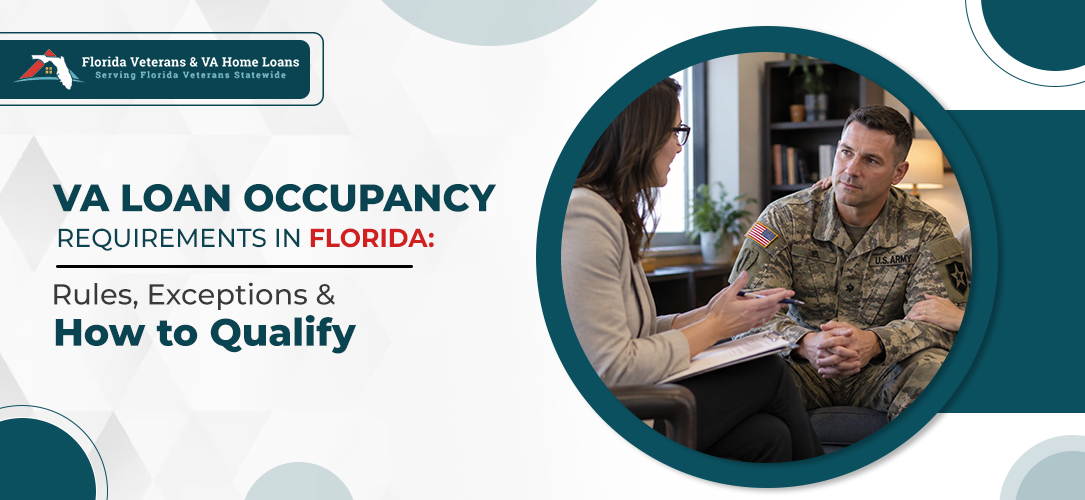
A PCS order or a tight closing timeline can make it feel like your VA loan is at risk before you’ve even moved in. It isn’t. The VA’s occupancy rule is more flexible than most buyers expect, with well-documented exceptions for deployment, retirement, renovation, and job transfers.
Below is a straightforward look at how occupancy works for VA loans in Florida — the standard timeline, the exceptions that apply to active-duty members and their families, and what lenders actually check for.
Quick Summary: VA Loan Occupancy Requirements in Florida
| Scenario | Rule | Exception |
|---|---|---|
| Primary Home | Occupy the property as your main home | Cannot be used as a vacation or investment property |
| Timeline | Move in within 60 days of closing, in most cases | Can be extended to up to 12 months with documentation |
| Spouse | Spouse can satisfy the occupancy rule while you’re deployed | Family can occupy the home while you’re away |
| Tenure | Loan documents typically require a 12-month intent to occupy | A valid PCS can allow you to move sooner |
What Does "Primary Residence" Mean for a VA Loan?
The VA requires that the home you finance be your primary residence — the place you intend to live most of the year, not a second home, vacation property, or straight rental. During underwriting, you’ll sign an occupancy certification stating this intent.
Underwriters weigh this alongside your job location, family ties, and the distance between the new home and your work or duty station.
How Soon Do You Have to Occupy a Home With a VA Loan in Florida?
1. The 60-Day Standard
No VA statute sets an exact number of days. The regulation instead requires occupancy “within a reasonable time” after closing. In practice, most VA-approved lenders—including CrossCountry Mortgage—use a 60-day standard, since that’s a period underwriting can reliably verify. Ask your loan officer to confirm the timeline your specific lender is using.
2. Can You Move In More Than 60 Days After Closing?
Yes, when you have documentation to support the delay. Common qualifying reasons include:
- Active-duty orders that keep you away from the area
- Retirement, when your move-in date lines up with your separation date
- Ongoing construction or repairs needed before the home is livable
- A late relocation or job transfer
With the right paperwork, you can typically defer occupancy up to 12 months from closing.
3. How Long Do You Need to Live There Afterward?
The VA itself doesn’t set a minimum holding period. Your loan documents will include a certification stating your intent to occupy the home for at least 12 months.
That’s a statement of intent at closing, not a legal minimum stay — but it’s the standard lenders will point to if your plans change shortly after you move in.
VA Occupancy Requirements for Active-Duty Service Members
Deployment orders don’t disqualify you from a VA loan or put your occupancy status at risk.
The VA has specific accommodations for service members who can’t be physically present right away:
- Married service members: Your spouse can satisfy the occupancy requirement by living in the home while you’re deployed.
- Single service members: You can meet the requirement by certifying your intent to occupy the home once your deployment or orders end, along with documentation of your expected return.
- Dependent children: If a spouse isn’t available, a dependent child living in the home under a legal guardian may satisfy occupancy in some circumstances — this is handled case by case, so confirm with your lender.
Can You Get a VA Loan If You Can't Move In Right Away?
Yes. Documented delays — deployment, an upcoming retirement, a job transfer, or a home that needs repairs before it’s livable — don’t cancel your approval. Your lender will ask for supporting paperwork (orders, a retirement application, an employer relocation letter, or a contractor’s timeline) to justify the delayed move-in date.
Can You Use a VA Loan to Buy a Second Home?
Not as a second home in the vacation-property sense — but if you have remaining entitlement, you may be able to use “second-tier entitlement” to finance a new primary residence while keeping your VA loan on a previous home.
This typically comes up for service members who are PCSing and want to buy in their new location without first selling the old home.
The amount of entitlement available depends on your county’s loan limit and what you’ve already used, so it’s worth a direct conversation with your lender before you start house-hunting.
For more information, you can explore our guide on ‘Buying a Second Home with a VA Loan in Florida‘.
Can You Rent Out Your Current Home and Buy Again in Florida?
Generally, yes. If you’re relocating and converting your previous home into a rental, lenders can often count a portion of the expected rental income toward qualifying for your new VA loan, provided you can document a lease and, in many cases, some landlord experience or reserves.
The specifics vary by lender, so get this pre-approved in writing rather than assuming it.
Can You Buy a Multi-Unit Property With a VA Loan?
Yes. VA loans can finance a duplex, triplex, or fourplex with no down payment, as long as you occupy one unit as your primary residence within the standard timeline.
You can rent out the remaining units, and in many cases, projected rental income from those units can help you qualify for the loan.
Can You Rent Out a Florida Home After Buying It With a VA Loan?
Once you’ve satisfied the initial occupancy requirement—typically by living in the home for around 12 months, consistent with the intent you certified at closing—you’re generally free to move out and rent the property, whether due to a PCS, a new job, or a change in plans.
This isn’t an exception that requires special approval; it’s the normal lifecycle of a VA-financed home after the occupancy period has been met.
What Properties Meet VA Occupancy Requirements in Florida?
| Property Type | Eligible? | Occupancy Rule |
|---|---|---|
| Single-Family Home | Yes | Move in within the standard timeline |
| Condo / Townhouse | Yes | Move in within the standard timeline |
| Duplex / Fourplex | Yes | Occupy one unit as your primary residence |
| Vacation / Pure Rental Property | No | Not eligible — VA loans require owner-occupancy |
VA Loan Occupancy Exceptions in Florida
- Active duty: A spouse can physically occupy the home, or a single service member can certify valid intent to occupy after deployment.
- PCS orders: A move tied to new orders for your next primary residence counts toward meeting the requirement.
- Job transfer: A transfer that makes commuting from the new home impractical can support a delayed move-in.
- Renovations: The occupancy clock can be paused until construction or required repairs are complete — see our guide on VA loan inspections for more detail.
- Spouse or dependent: Family can occupy the home during TDY assignments or remote duty.
How Do Lenders Verify Occupancy?
Underwriters check occupancy intent both before and after closing. That typically includes your signed occupancy affidavit, confirmation of your employer and commute distance, and documentation like utility transfers or a driver’s license address change after you move in.
Some lenders will also follow up months later to confirm you’re still living there, particularly if anything in your file (like a rental property nearby) raised a flag.
What Happens If You Don't Meet VA Occupancy Requirements?
Misrepresenting your intent to occupy is treated as mortgage fraud, since it’s a federal loan guaranty program. If a lender determines the occupancy certification was false, they can call the loan due and payable immediately, and in serious cases, refer the matter to federal authorities.
This is a real risk, but it’s also avoidable — if your circumstances change legitimately after closing (a new job offer, a family emergency), talk to your lender promptly instead of letting the certification go unaddressed.
Common VA Occupancy Mistakes to Avoid
- Buying with vacation-home intent. Using VA’s zero-down benefit for a property you plan to use seasonally isn’t compliant.
- Submitting documentation late. Deployment orders, retirement paperwork, or contractor timelines must reach your lender before underwriting questions come up, not after.
- Overlooking Florida-specific insurance requirements. Windstorm coverage can affect your closing costs and timeline — see our guide on homeowners insurance for VA loans in Florida.
- Working with a lender unfamiliar with military moves. Occupancy exceptions require specific documentation; a lender who doesn’t handle VA loans regularly may not structure your file correctly the first time.
Florida VA Home Loans—Where Florida Veterans Build Their Future
Occupancy exceptions are approvable, but they need to be documented and presented to underwriting correctly. Shirley Mueller has worked with Florida veterans navigating deployments, retirements, and PCS timelines since 2003, and can help make sure your file reflects your actual situation from the start.
Have questions about your specific VA loan process? Schedule a call or apply online to get started.
Frequently Asked Questions
1. How long do I have to occupy a home after closing on a VA loan in Florida?
Most lenders, including ours, work off a 60-day standard, since that’s the window VA’s “reasonable time” requirement is commonly interpreted to mean in practice.
There’s no fixed number written into VA regulation itself — it comes down to how your specific lender applies the rule. If your move-in will take longer than that, flag it to your loan officer before closing, not after.
2. Can I move into my Florida VA home after 60 days?
Yes, as long as you have documentation supporting the delay — deployment orders, a retirement date, or an active construction timeline are the most common examples. Lenders can typically approve occupancy delays of up to 12 months when the paperwork is in order. Without documentation, though, a long gap between closing and move-in can raise questions during underwriting or in a post-closing review.
3. Can my spouse occupy the Florida home if I work in another state?
Yes. A spouse living in the home full-time generally satisfies the occupancy requirement on your behalf, which is common for military families dealing with remote assignments or extended TDY. Your lender may still ask for documentation showing why you personally aren’t residing there, such as orders or an employer relocation letter. This exception is one of the most frequently used, so it’s usually a smooth part of the file if you disclose it upfront.
4. Can active-duty military members get an occupancy exception?
Yes. Deployed service members can meet the requirement either through a spouse or dependent physically living in the home, or by personally certifying intent to occupy once deployment ends. The VA recognizes that military life doesn’t always allow for a same-day move-in, so this exception is built into the program rather than something you have to fight for. Your lender will need documentation of your orders and expected return timeline on file.
5. Do I have to live in the home for a certain number of years?
No — the VA doesn’t set a multi-year minimum hold period. At closing, you’ll sign a statement of intent to occupy the home for about 12 months, which is more of a good-faith commitment than an enforceable deadline. After that period, most owners can move, rent the property out, or sell it without needing further approval. Life changes that happen sooner (a new assignment, a family situation) are generally fine as long as you’re transparent with your lender if asked.
6. Can I buy a duplex or fourplex with a VA loan in Florida?
Yes, VA loans can finance properties with up to four units, with no down payment required. The occupancy rule applies to just one unit—you need to live there as your primary residence within the standard move-in window, and you can rent the remaining units from day one. In many cases, projected rental income from those other units can help you qualify for the mortgage, making multi-unit VA purchases a popular option for building rental income alongside homeownership.
7. Does a VA lender verify occupancy?
Yes. Lenders check both at closing and afterward — your signed occupancy affidavit is the starting point. Underwriters may also review your employer’s location, your commute distance, and later documentation like a utility bill or a driver’s license address update. Some lenders do periodic post-closing reviews, especially if something in the file (like owning another property nearby) warrants a second look. This isn’t meant to be adversarial — it’s how the program protects the VA guaranty for everyone using the benefit.
8. What happens if I cannot move into my VA home within the standard timeline?
Contact your lender as soon as you know there’s a delay, rather than waiting until it becomes an issue. Underwriters can review documentation like deployment orders, a retirement application, or a signed contractor agreement to approve a longer move-in window. The earlier you disclose and document this, the more straightforward approval tends to be — problems typically arise when a delay surfaces after the fact rather than being addressed proactively.
9. Can a veteran use a VA loan if they work away from home during the week?
Yes, as long as the property functions as your actual home base — meaning you return regularly, you don’t maintain a separate primary residence elsewhere, and your community ties (mail, registration, family) point to that address. This comes up often for veterans with jobs that involve regional travel or a weekly commute to a different city. It’s a good idea to discuss your specific work pattern with your lender upfront so it’s documented correctly, not assumed.
10. Can my dependent child satisfy the VA occupancy requirement?
In some cases, yes—particularly when a single service member is deployed, and a dependent child lives in the home under a legal guardian. This isn’t as automatic as the spousal exception, so lenders typically evaluate it case by case with documentation of the guardianship and living arrangement. If this situation applies to you, raise it with your loan officer early so they can confirm how your specific lender will handle it.
11. Can I buy a VA home in Florida while deployed overseas?
Yes. A spouse can occupy the home in your place, or if you’re single, you can certify your intent to move in once your deployment ends, supported by your orders and an expected return date. This is a well-established use case for the VA loan program, since deployment timing is often outside a service member’s control. Your loan officer will typically walk through exactly what documentation underwriting will want to see for your situation.
12. Can I buy a Florida home before my military retirement?
Yes, VA guidelines generally allow a purchase up to about 12 months ahead of your separation or retirement date. You’ll need to provide proof of your retirement paperwork along with documentation showing your post-retirement income (pension, new employment, disability compensation, etc.) will support the mortgage payment. This is a common scenario for veterans planning where to settle after service, so lenders experienced with VA loans should have a clear process.
13. Can I get a VA loan if the home needs major repairs before I can move in?
Yes — a VA renovation loan lets you finance necessary repairs alongside the purchase, and the occupancy clock is typically paused until the work is finished and the home is livable. This differs from simply having a longer move-in window; it’s tied specifically to construction completion. Your lender and the assigned contractor will coordinate a timeline that supports both the renovation and the occupancy certification.
14. Can I use a VA loan for new construction in Florida if the home isn’t finished at closing?
Yes, VA loans can finance new construction with no down payment. In this case, the occupancy timeline generally doesn’t start until the builder completes the home and it receives its certificate of occupancy from local authorities. This protects buyers from penalties for delays outside their control, like permitting timelines or supply issues during the build.
15. Can I buy a Florida home with a VA loan and live there only part of the year?
No. VA loans are for primary residences, so a property you’d only use seasonally—even if it’s technically your favorite place to spend the winter—doesn’t meet the occupancy requirement. If you genuinely spend most of your time elsewhere, this isn’t a fit for the VA benefit, and a conventional loan or second-home financing is the more appropriate path.
16. What documents can support a delayed VA loan occupancy?
The most common supporting documents are dated deployment or PCS orders, a signed retirement application, an employer relocation or job transfer letter, and a contractor agreement with a completion timeline for renovations. Lenders generally want these submitted as early as possible rather than after questions come up in underwriting. If you’re unsure what applies to your situation, ask your loan officer directly what they’ll need before you’re deep into the process.
Guidelines are subject to change, and approval depends on VA eligibility, borrower credit, property appraisal, contractor approval, and underwriting and lender approval.
archives
Archives
recent posts




About the Author
VA Loan Specialist Shirley Mueller!
Working as a loan originator since 2003, Shirley has helped over 3000 Veterans with VA Home Loans. She has helped Veterans in almost every situation, including deployed personnel returning home or those with PCS orders. Shirley also helps disabled Veterans who…
“Shirley Mueller is Sr. VP of Veteran Lending, NMLS ID 336103. She has helped 3,000+ military families since 2003, specializing in entitlement analysis, residual income review, and VA program structuring. Her practice is referral-driven, built on decades of trusted results for veteran homebuyers and builders.
CrossCountry Mortgage, LLC | NMLS ID: 336103 (Shirley Mueller). Equal Housing Lender. CrossCountry Mortgage, LLC is not affiliated with or acting on behalf of the Department of Veterans Affairs or any government agency.
A Certificate of Eligibility is required for VA loans. NMLS #3029, MB 803095. This article is for general information only and is not a commitment to lend; contact us to discuss your individual eligibility, rates, and terms.
